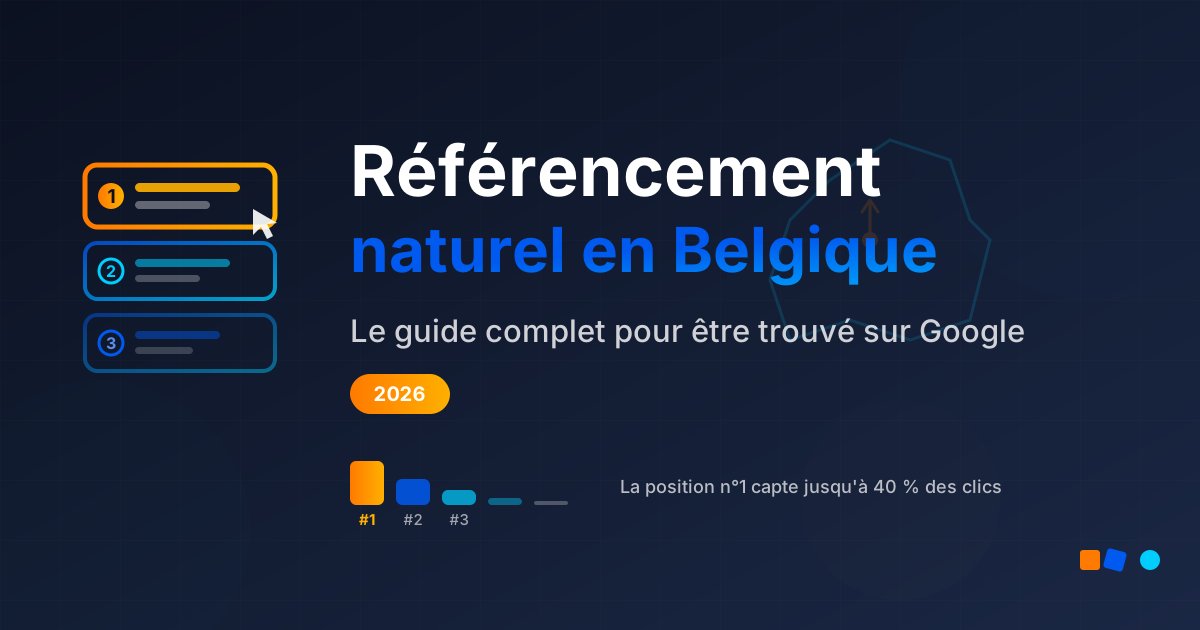
Search engine optimisation (SEO) is the art of showing up in Google's results when your future customers search for what you sell. It is the most profitable acquisition channel in the long run, and also the one where the wildest promises circulate. This guide lays down the real foundations for the Belgian market: every figure was verified at its source in August 2026, and all references are listed at the end of the article.
The essentials in 30 seconds
- In Belgium, Google handles roughly 9 searches out of 10 (88.5% market share in July 2026). Doing SEO in Belgium means doing SEO for Google.
- Position is everything: the first spot captures 28 to 40% of clicks depending on the study, while page 2 captures 0.63%.
- Google's AI summaries sharply reduce clicks when they appear: value concentrates in the top 3, featured snippets and brand searches.
- SEO rests on 4 pillars: technical health, content, authority and local.
- Be patient and sceptical: the average page ranking #1 is about 5 years old, and fewer than 2% of new pages reach the top 10 within a year. Run from « first page in 30 days » promises.
In Belgium, searching the web means searching Google
According to StatCounter, Google held 88.46% of the Belgian search market in July 2026, across all devices. Bing follows at 7.8% (mostly on corporate desktops), and the rest share crumbs. The pragmatic conclusion: optimising for Google covers the bulk of your visibility, and Google best practices benefit the other engines anyway.
Why position matters so much: the click numbers
Being « on Google » is not enough; you need to be high up. The two reference studies diverge on absolute values but tell the same story: FirstPageSage measures 39.8% of clicks for position 1 (on results pages without extra features), Backlinko measures 27.6% across all situations. In both cases, the top 3 concentrates 54 to 69% of all clicks, and position 1 receives about 10 times more clicks than position 10. As for page 2, it captures a mere 0.63% of clicks: it might as well not exist.
A useful detail: the featured snippet outperforms even the classic position 1, with a 42.9% click-through rate. Structuring your content to earn it (direct answers, lists, FAQs) is a goal in itself.
Zero-click and AI summaries: the new deal
Two phenomena are reshuffling the cards. First, zero-click searches: according to SparkToro, 59.7% of European searches already ended without any click in 2024, and the US measurement climbed to 68% in early 2026. Then Google's AI Overviews: the Pew Research Center, analysing 68,879 real searches, observed that the click rate on classic results drops from 15% to 8% when an AI summary appears. Ahrefs measures a drop of about 34.5% in click-through rate for position 1 on affected queries, and more recent data suggests even steeper declines. Google disputes some methodologies, and Semrush adds nuance: by its measurements, 15 to 25% of queries display an AI summary and the impact varies widely from one query to another.
The takeaway: SEO is not dead, it is concentrating. The top 3, featured snippets, brand awareness and local search (whose map packs still get clicked) capture most of the remaining value. And a new discipline is emerging: being cited as a source by the AIs themselves, a topic we will cover in a dedicated article.
The 4 pillars of search engine optimisation
1. Technical health: a site Google can read and enjoy
Before any talk of content, Google must be able to crawl, understand and serve your site quickly. The fundamentals: clean indexing (sitemap, robots.txt, canonical tags), a clear structure, HTTPS, and the Core Web Vitals, the three experience metrics Google confirms its ranking systems use: LCP (loading, good if under 2.5 s), INP (responsiveness, under 200 ms, which replaced FID in 2024) and CLS (visual stability, under 0.1). Google specifies that relevance always comes first: speed mostly separates content of equivalent quality.
A lived example: rebuilding the site of a Brussels HVAC installer, we brought an audit from 349 errors down to zero and the LCP from 6.2 to 2.0 seconds. Without changing a single line of content, the site went from unindexable to ranking healthily. Technical health is not everything, but it caps everything else.
2. Content: answering a real question better than everyone else
Every page should target one precise search intent: one question, one page, one complete answer. This is where Google's E-E-A-T comes in (experience, expertise, authoritativeness, trustworthiness): cite your sources, show your real cases, sign your content, date it. Mass-produced generic content is precisely what AI summaries replace; lived experience and original data are what they cite.
3. Authority: what others say about you
Inbound links remain a major signal: one link from a respected site beats fifty dubious directories. In Belgium, the realistic levers are local and trade press, professional federations, partners, suppliers and clients. Consistency beats volume, and shortcuts (bulk link buying) end in penalties.
4. Local: where the clicks still are
For a business serving a geographic area, local search offers the best effort-to-result ratio. The Whitespark 2026 study (47 experts) ranks the local pack signals in this order: Google Business Profile, reviews, user engagement, links, on-page optimisation. On the behaviour side, the BrightLocal 2025 survey (US consumers, trends that transpose well) shows that 96% of people read reviews of local businesses, that 84% read them on Google and that around 9 in 10 expect the business to reply. Optimising your Google Business Profile and your review strategy is often the first profitable project.
How long before results? The real numbers
It is the awkward question, so let's answer it with data rather than promises. The Ahrefs study of May 2025 (1.3 million keywords analysed) shows that the average page in position 1 is about 5 years old, that 72.9% of top-10 pages are more than 3 years old, and that only 1.74% of recently published pages reach the top 10 within a year. Fast breakthroughs (2 to 6 months) exist, but almost exclusively on sites that already carry authority or on low-competition queries.
Two practical consequences. One: anyone guaranteeing you the first page in 30 days is either lying or targeting worthless queries. Two: SEO should be managed as an investment, with a 12-to-18-month horizon for competitive queries. This is exactly why our engagements are built for the long run: the time it takes to build results that, in turn, last.
Where to start: the audit above all
Whether you handle SEO yourself or delegate it, the starting point is the same: a complete audit answering three questions. Is the site technically sound? Do the pages target the right queries? What separates the site from its direct competitors? From there flows a prioritised action plan: fix the technical layer, strengthen or create content, build authority, measure. Our full approach is detailed on our SEO optimisation page.
Our experience: two concrete, quantified cases
The Tropical Hotel in Durbuy is our favourite demonstration of SEO as an investment: #1 position on its main query, more than 1,300 direct bookings generated without a euro of advertising, and booking-platform commissions saved on every reservation. In a completely different sector, the technical rebuild of the HVAC site mentioned above (349 audit errors brought to zero, load time divided by three) made an invisible site indexable despite decent content. Two different paths, one logic: diagnose, fix, produce, measure.
Curious where your site stands? Request your audit: an honest assessment, a prioritised action plan, and no promise of miracles in 30 days.
FAQ
What exactly is search engine optimisation?
The set of techniques that improve a site's position in Google's unpaid results: technical health, content that answers real searches, authority (inbound links) and local presence. Unlike advertising, positions earned keep producing visits with no cost per click.
How long does it take to rank well?
Expect 6 to 12 months for the first measurable results and 12 to 18 months for solid positions on competitive queries. Ahrefs data shows that fewer than 2% of new pages reach the top 10 within a year: guarantees of immediate results are a red flag, not an argument.
Does SEO still work with AI in Google?
Yes, but differently. AI summaries reduce clicks on purely informational queries and concentrate value in the top 3, featured snippets, brand and local search. Content built on real experience, sourced and dated, is also what the AIs cite: the bar rises, the principle stays.
SEO or Google Ads: which should I choose?
They answer different needs. Advertising brings immediate traffic but stops with the budget; SEO takes months but builds a durable asset whose cost per visit drops over time. The classic combination: Ads to test queries and cover the short term, SEO to build the long term.
How much does SEO cost in Belgium?
It all depends on the starting point (technical state of the site) and the ambition (target queries, area, competition). At Webedia, SEO is part of our all-inclusive monthly plans, with an audit as the entry point and a transparent, itemised quote. The cost of the website itself is detailed in our pricing guide.
Sources
- StatCounter: search engine market share in Belgium (July 2026)
- FirstPageSage: Google CTR by ranking position
- Backlinko: Google CTR stats (updated April 2025)
- SparkToro: 2026 zero-click study
- Pew Research Center: AI summaries and click behaviour (July 2025)
- Ahrefs: AI Overviews reduce clicks (April 2025)
- Semrush: AI Overviews study (updated December 2025)
- Google web.dev: Core Web Vitals, official metrics and thresholds
- Google Search Central: page experience in results
- Whitespark: Local Search Ranking Factors 2026
- BrightLocal: Local Consumer Review Survey 2025
- Ahrefs: how long it takes to rank on Google (May 2025)
Written in August 2026. Market shares, CTR studies and Google's AI features evolve constantly: the figures cited are those verified at publication date.